Winery & Tasting Room Tumblers: Branded Retail That Sells
Every tasting room already sells the pour. The harder question is what a guest carries out the door after the flight is finished — and for a growing number of estates, the answer is a branded insulated tumbler. Winery wine tumblers have quietly become one of the best-margin, highest-repeat items on the cellar-door retail shelf: they cost little to produce at volume, they photograph beautifully next to a bottle, and unlike a logo cork or a branded pen, they ride around in a customer’s car cup holder for years advertising your label. This guide covers why branded winery drinkware works as retail, how to price it, which decoration method survives the dishwasher, and how the same tumbler doubles as a wine club gift.
Why Winery Wine Tumblers Outperform Most Tasting-Room Merch
Walk any cellar door and you will see the usual suspects: t-shirts nobody’s size is left in, corkscrews from a catalog, stemware too fragile to survive checked luggage. Winery wine tumblers solve the three problems those items create. They are one-size-fits-all, so you are not managing a size matrix. They are unbreakable and TSA-friendly, so the out-of-state guest actually takes one home. And they are useful every single day, which turns a one-time souvenir into a rolling billboard for your brand.
The retail math is the real story. A stemless insulated tumbler decorated with your logo carries a healthier margin than almost anything else on the shelf, and guests who just spent an afternoon falling for your rosé are in the exact frame of mind to add a $32 keepsake to the bottle order. That combination — low unit cost, high perceived value, impulse timing — is why branded winery drinkware has become a fixture of modern tasting room merch.
Margin by Price Point
The temptation is to price a branded tumbler cheap to move volume. In practice, the cellar-door guest is not price-shopping against a big-box mug; they are buying a memory of your estate. Margins climb as you move up the price ladder, because your decoration and freight cost per unit stays nearly flat while the retail price rises.
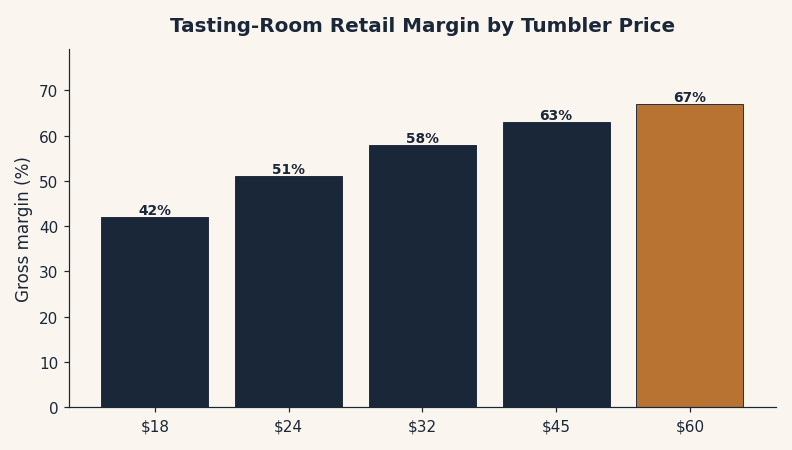
The sweet spot for most estates sits in the $28–$45 band: high enough to protect margin and signal quality, low enough to clear as an impulse add-on to a bottle purchase. Reserve the $60 tier for a limited estate-series design or a boxed gift set.
Choosing the Right Tumbler and Decoration Method
A cellar-door tumbler has to survive real life — beach days, dishwashers, and the bottom of a tote bag full of bottles. The vessel matters, but the decoration method matters more, because a logo that peels after a month does the opposite of brand-building.
Decoration Durability
There are five common ways to put your winery’s mark on a tumbler, and they are not remotely equal. Laser engraving cuts the logo into the steel (or through powder coat to the metal beneath) so it can never wear off. UV and screen printing look sharp but sit on the surface. Vinyl decals are cheapest and fail first.
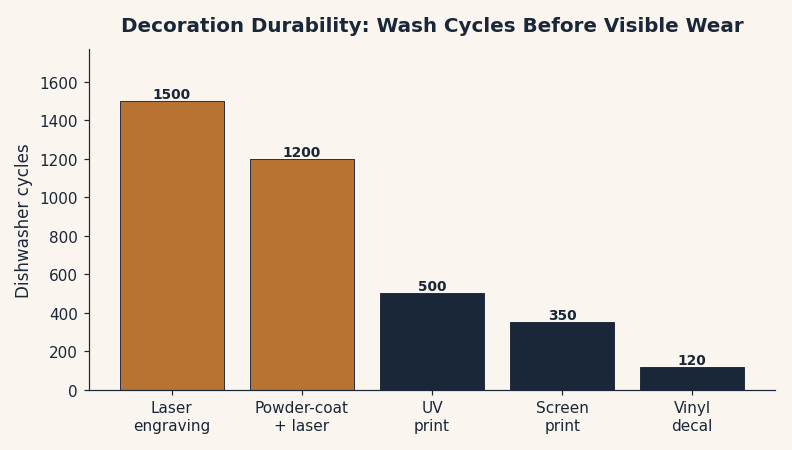
For retail you are selling to strangers who will not baby the product, laser engraving or powder-coat-plus-laser is the only choice that protects your reputation. Save UV print for full-color estate artwork where the design demands more than one tone, and skip vinyl entirely for anything carrying your name.
Turning Tumblers Into Wine Club Gifts
The same tumbler that sells at the counter is a ready-made wine club gift. Club retention lives and dies on members feeling like insiders, and a members-only engraved tumbler — a design or color the public shelf never gets — is a cheap, high-perceived-value way to say thank you at renewal or on a shipment milestone.
Estates run this a few ways: a welcome tumbler in the first club shipment, an annual members-only color drop, or a tiered gift where higher club levels get a boxed pair. Because you are ordering the same base product you already stock for retail, the incremental cost is just the members-only engraving plate, and the goodwill it buys against a churn-prone subscription is disproportionate.
Bundling With the Bottle
The highest-converting cellar door retail move is the bundle: a bottle of the current release plus a matching engraved tumbler at a gentle package price. It lifts the average order value, moves drinkware without discounting it alone, and gives the tasting associate an easy, non-pushy upsell line at checkout. We break down more counter-merchandising ideas across the blog.
Ordering for a Tasting Room: What to Get Right
Branded retail only works if the product is consistent shipment to shipment. A few things separate a program that compounds from a one-off box of tumblers that sits in the stockroom.
| Decision | Recommendation | Why it matters |
|---|---|---|
| Size | 10–12 oz stemless | Reads as “wine,” fits a cup holder, TSA-friendly |
| Decoration | Laser engraving | Never wears off; protects brand |
| Color | Match flagship label | Sells as a set with the bottle |
| Reorder | Keep art on file | Shipments match year over year |
Ask your supplier to keep your logo file and engraving setup on record so every reorder matches the last, confirm minimums early (most estates start with a run they can sell through in a quarter), and request a physical proof before the first production run. Learn how we handle winery accounts and proofing on the about page.
Rolling Out Beyond the Tasting Room
Once the counter program is working, the same branded winery drinkware carries into event pouring, wine-and-food festivals, and corporate gift orders from restaurant and distributor partners. If you also host weddings or private events at the estate, the tumbler crosses over into favor territory — our companion guide to wine tumblers as wedding and event favors covers that use case in detail.
Frequently Asked Questions
What is the minimum order for branded tasting-room tumblers?
Most estates start with a run they can sell through in a single quarter rather than over-committing on the first order. Once a design proves itself on the shelf, reorders scale up and the per-unit cost drops. Keeping the artwork on file means those follow-up runs match the original exactly, which matters when a repeat guest wants a second one for a spouse.
Are engraved tumblers dishwasher safe?
Yes. Because laser engraving marks the steel itself rather than sitting on the surface, engraved winery wine tumblers hold up through hundreds of dishwasher cycles without fading. That durability is exactly why engraving beats vinyl and print for a product you are selling to guests who will not read a care label.
Can we use one tumbler for both retail and the wine club?
Absolutely, and it is the most efficient approach. Stock one engraved base design for the retail shelf, then order a members-only color or a small design tweak for club shipments off the same setup. You get two distinct offerings from one product line without doubling your inventory or setup costs.
The Takeaway for Cellar Door Retail
Branded winery wine tumblers do three jobs at once: they add a high-margin item to your retail shelf, they reward and retain wine club members, and they send your label home in a customer’s daily rotation. Choose a durable decoration method, price for margin rather than volume, match the glass to your flagship bottle, and keep the artwork on file so the program compounds. Done right, the tumbler is not a souvenir — it is the cheapest ongoing advertising your estate will ever buy.
Put your label in every cup holder in the county.
Laser-engraved winery tumblers, color-matched to your flagship label, with your artwork kept on file for effortless reorders.
Get a QuoteWin Free Stuff
Enter below for a chance to win plus receive 10% off your first order.
🎉 You are in!
Check your email for your 10% off code. Good luck!